New Publication
One mobile map does not fit everyone: a research agenda for responsibly adapting mobile maps for all
Cartography and Geographic Information Science
Tumasch Reichenbacher, Mona Bartling, Armand Kapaj, Donatella Zingaro, Peter Kiefer, Toru Ishikawa
Abstract
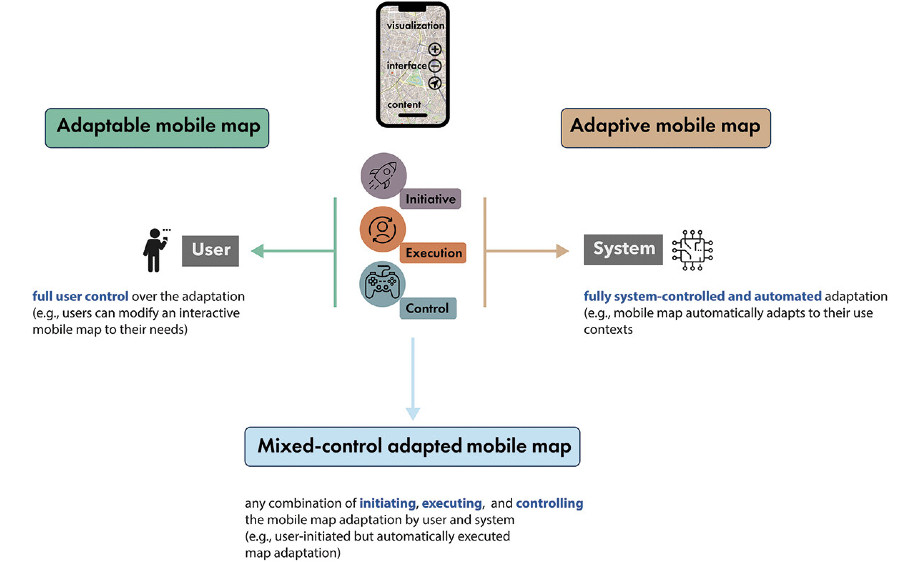
Mobile map applications have become indispensable tools for everyday spatial decision-making and tasks. Yet, they commonly exhibit a one-size-fits-all design, offering only limited, mostly ad hoc adaptations (e.g. dark mode, speed-dependent zoom) that are insufficiently grounded in empirical evidence about diverse users and contexts. This paper synthesizes interdisciplinary research on mobile map adaptation and proposes a research agenda for responsibly adapting mobile maps for all. Building on foundational work in context-aware systems, adaptive user interfaces, location-based services, and adaptive cartography, we define mobile map adaptation as a flexible approach that shares initiative, execution and control between the user and the map application. Through an illustrative scenario, we highlight both the potential of adaptive assistance (e.g. context-aware rerouting) and the risks of inappropriate or suboptimal adaptations (e.g. unsafe routing due to erroneous context inference). To advance the field, we identify 19 research opportunities across seven topics: (1) adverse effects and trade-offs, (2) conflicting adaptation objectives, (3) initiation, frequency, scope, and magnitude of adaptation, (4) user control, human error, and overreliance, (5) explainability, (6) data privacy, and (7) uncertainty. The research agenda provides practical directions for developing adaptive mobile maps that empower diverse users while addressing practical, ethical, and societal implications.
https://doi.org/10.1080/15230406.2026.2710916